Adam and Dani are naturally social children, and Jon and I recognise that their friendships are an important part of their wellbeing. Despite being a teacher, my main concern about a year of life out of school is not about our children’s education, but is the impact of being away from their friends. Danielle is 10 years old, and at that age, a year represents a significant portion of her life.
When I was in grade 6 (primary school), my best friend moved to Indonesia for a year. I found her absence very difficult, as she was the only peer who truly understood me. Even so, I felt that the experience was even harder for her.
We exchanged many letters during that time. I vividly remember the excitement of receiving one of her letters and how I would savour opening it and reading it slowly. She shared both the exciting and challenging aspects of her life. Her experiences often felt so foreign to me that, despite my efforts to imagine her world, I struggled to piece together her stories. I had so little experience of life beyond Australia that her reality felt almost impossible to fully grasp.
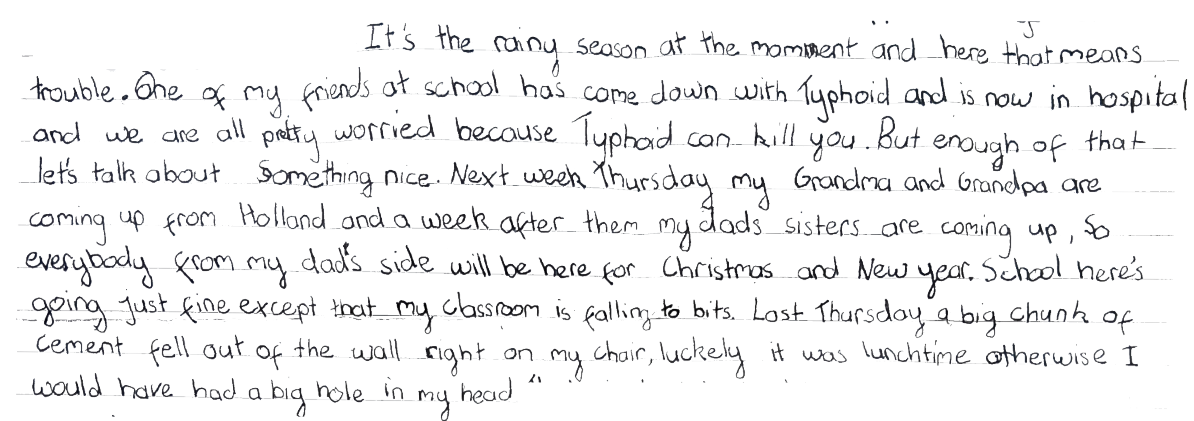
My fantasy involved giant carbuncles, Christmas trees, and a piece of cement the size of my head, which were all inaccurate.
Today, she is one of the most worldly people I know. I felt she would be an ideal person to offer first-hand perspectives on what life is like for an Australian child living in Indonesia, as well as insights into the value of travel for children. She kindly agreed to be interviewed and even offered me a delicious dinner and a place to stay for the night—a wonderful opportunity to reconnect with an old friend.
I hope you enjoy learning from my friend’s insights.
Conversation with Friend
Travel as a Family Culture
Emelie: Tell me about why your parents took you to Indonesia?
Friend: My parents are travellers from way back, especially mum. Mum was born in the Netherlands but at a very young age moved to Indonesia for her dad’s work. They were on an island near PNG as well called Manokwari and lived there for a while. They were also in South America, in Suriname, which was formerly a Dutch colony. So I think by the time Mum came back to Holland she was in her late teens.
Then she met Dad and moved to West Indies, which is where my sister and I were born, then migrated to Australia. They both had studied Indonesian at University and were teaching Indonesian when I was in primary school. This opportunity came up to teach in Indonesia for a year and Mum and Dad thought, “Well, why, why not?”
I remember them coming to pick us up from school and they said, “Alright, we’re going to Indonesia.” And that’s pretty much what happened.
Feelings Before Leaving
Emelie: That’s pretty wild. How did you feel about being told that you’re going to Indonesia?
Friend: I don’t think it occurred to mum and dad that it would be anything different. I think that my sister and I were nervous about it, but we were all so excited to see what it was like. My sister and I always had each other. So as long as we went together, we would be ok. I don’t remember being super apprehensive, but I remember thinking that I would miss my friends. I was also excited to try something new.
I remember Mum and Dad saying if you really, really don’t like it after having tried, then you might be able to go home and go and live with your aunt, who was living on the Gold Coast at the time. Just knowing that there was an out if we needed it made it easier. I didn’t feel trapped because I knew there were options. For my whole life, as long as I know I have options, I’m usually quite comfortable dealing with what’s in front of me. It’s when I feel like I don’t have options that I find things harder.
First Impressions
Emelie: What were the kind of first things that struck you when you went to Indonesia?
Friend: Smell was the thing for me. Indonesia was very different to Australia. There were open sewers and drains. That, combined with the humidity and the busyness. I remember being nervous and a bit apprehensive and just going “Ohh my goodness, what have we gotten ourselves into?”
Mum and Dad enrolled us in a local school, which was just around the corner from where we lived in Indonesia. It was sink or swim. The school had mud brick walls and chicken wire at the top. I remember sitting down at my desk and I went out to get something. And part of the wall fell down on top of my desk while I was out.
It was also such a different culture. The students had the utmost respect for their teachers. They didn’t do anything their teachers didn’t say. We started school at 6:00 in the morning. One day during Ramadan, at about 9 am, the teacher left and never came back. The kids are not allowed to leave the classroom unless the teacher lets them go. We were all still sitting there at 12:00 when one of the parents wondered why the kids hadn’t come home. They called the principal, who had to come in and tell the class that they were dismissed. I remember sitting there thinking that this would never happen back in Australia.
Emelie: It sounds enticing to teach in Indonesia. Sometimes here it’s hard keeping the kids inside the classroom.
Friend: It was hard, but it was a worthwhile experience. I’d say it’s one of the experiences that has shaped me into who I am now.
Lifelong Impact of Living in Indonesia
Emelie: In what ways do you feel you were shaped?
Friend: Resilience. Knowing that when things get really hard, I could do it. After that trip, I also became so aware of how fortunate I was in life. I was in Grade 6 and the girls in my class wouldn’t go past Grade 7. They would be having kids, and that was never going to be my journey. It was a real eye opener. I knew I was going to finish high school and go to university. It was really shocking to know that wasn’t an option for the other girls. I felt really fortunate.
Emelie: Were there other moments that made you think differently about what’s really necessary or valuable?
Friend: Probably the whole experience taught me that as long as we were together as a family, there really wasn’t a lot outside of that we needed. You can build a home. You can build a sense of safety, happiness, and security. You don’t need things for that. You just need each other. That experience probably just really highlighted that if you’ve got a strong base there then there’s not much you can’t tackle.
It’s also the importance of relationships. Having new experiences together, going through challenges together, doing things that are hard together really strengthens your relationships and bonds with each other. And they make for some of the best memories. Because that’s the things you remember, right? As you make memories together and do new things, you expand your mind. I impressed myself by doing things that I had never done before.
It’s so easy when you’re at home in the daily routine of life to just stay in your comfort zone. I would say that whole year was me out of my comfort zone and I did it. So when I came back, I thought “OK, I did that”. So there’s not much that I wouldn’t take on.
Friendships Developed in Indonesia
Emelie: Do you feel like you made close friends or close connections while you were there?
Friend: We had a lady who lived with us and would help with the cooking and the cleaning. She was amazing. I would say we had a really close connection with her. After we came back we brought her out to Australia to come and see us.
In terms of kids my age, probably not. We were friendly, but I would never say we were really good friends. I think that’s just because our lives were too different. We would play badminton and go walking around the streets and hang out together, but weren’t good friends in the sense that I had good friends at home.
In some situations I had to contend with their perception of what white girls represented. It was confronting. I remember in class some girls asking if they could look down my shirt because they wanted to see if I looked the same as everybody else. It was grade 6 when all that change was starting to happen. I found that challenging to deal with.
If I hadn’t had my sister there, it would have been a lot harder because she was going through the same thing as I was. I think if I hadn’t had that, I would have missed home a lot more.
Guilt for Taking Children Overseas
Emelie: It sounds rewarding and challenging. I feel some guilt already about taking our children overseas and keeping them from their friends for that time, and I expect it will be really hard for them.
Friend: Yes, but it also has the opportunity to shape their life, right? I think that Indonesia was great for perspective for me to understand how lucky I was. Nothing I did caused me to be lucky. That was just the decisions that my parents and my grandparents and my ancestors have made, and I’m lucky enough that I have been able to take advantage of that. But there are so many people who haven’t had the same opportunity who would love to. I did come back feeling a degree of responsibility to make the most of, and not squander, the opportunity that I’ve been given.
I think of my place in the world. The world is so big and wide and I have already won. We’re already in the top 1%. And I’m not owed anything. To be honest, I probably owe it to do something with the opportunity that I’ve been given.
That was some big stuff to think about in grade 6 and 7. And I think that’s something to be mindful of is when you come back, there will be an adjustment period because you’ve just had that experience and your friends haven’t. It takes a little while because they can’t relate to what you’ve just experienced.
Return to Australia
Emelie: What was that like for you?
Friend: It was tough initially because I had just gone through all these big world questions and I felt so lucky. Then I walked back into it a classroom where people didn’t want to learn, didn’t care and were rude. But also, I was so lucky to be there to have an education and to be able to go to high school the next year. And I’d just left a classroom where people would have killed to have had that opportunity. I did adjust, but it took time.
Emelie: What was your thought process that made it ok to be in the classroom with other students who seemed to take their opportunities for granted?
Friend: I thought “I can’t control others, but I can control me”. So I just focused on being responsible for myself and my own choices. I could have discussions with people, but I couldn’t control what anyone else did. I just came to peace with that.
Plus, it’s a tough age as well, right? Grade 6-7, I was different. And it’s not as though I wanted be different or stand out. So I think I probably just internalised. It became a bit of survival. Being different isn’t always accepted.
I think that if I look at all my friendship circles now and the people that I get along with best and what I do for a living, I think it’s all based around people who have had similar experiences to me.
Being Australian
Emelie: How do you feel about being Australian, or a global citizen?
Friend: I feel like being Australian is being a global citizen. If you look at Australia now, over half of Australians are from overseas or have a parent from overseas. I feel like Australia’s identity is still so new that it’s still being shaped by all the different cultures and the different people. I feel like some of the European countries have a more established Identity that’s been there for a really long time. But I feel like it’s new here.
I feel the proudest of being Australian when I go down to the foreshore here and I see people from all walks of life having a BBQ together or having a lunch, having a chat. All the kids are playing together, there’s no animosity. People talking to each other and learning things about each other and that’s what Australia is for me. It is the ability to do that freely in public spaces.
Final Comments
Emelie: What would you say to parents who want to raise kind, open hearted kids?
Friend: We should be more accepting. We should listen to each other’s stories, to each other’s views and I think if you can suspend judgement and just listen, you can learn a lot about yourself and about other people. When you listen, you find a commonality. You might actually find that you’re trying to say the same thing in a slightly different way. Or you can both achieve what you need.
Emelie: So you don’t think we’re crazy to sail to Asia?
Friend: I think do it and then see how you’re going. Give yourself permission to make a different choice if that is what you need in a particular time.
I think travel is a really important experience. We’re really keen to show our kids the world and the possibilities and perspective that you learn by getting outside of your daily routine of work, school, sport. Your life when you’re in your routine is very curated, right? You decide what experiences you’re having. And there’s not as much opportunity for external things to come. When you travel you’re not as in control of the experience you’re having, and I think that’s really important.
You can also take a step up and take a bigger picture of your life and ask “Am I actually happy with what I’m doing? Am I happy with my work? With what I’m doing outside of work? Am I happy with how I’m feeling in myself?” I think that’s really important to do every so often.
Getting outside of your daily routine is indeed important. Sometimes you only have to travel a mile (or not at all) to achieve this..