
Wait, isn’t this the Good Life?
I picked up The Good Life from a marina library enroute to Sydney. Surely I was living the good life already. At least I thought so. Beautiful sunsets, mild weather, frolicking dolphins, moving under the power of the wind and plenty of time for reflection. As it turns out that’s not the “good life” that Australian author Hugh Mackay is referring to.

What Mackay means by “good”
I initially assumed “the good life” referred to happiness or fulfillment. A life free of unnecessary struggle. It seemed fitting, given how easy my passage through life and the Australian coast line had been. But Mackay uses the word far more narrowly. “Good” in his work refers to the moral definition, not to pleasure or ease.
Happiness and fulfilment may follow from being or doing good, but they are not guaranteed to and Mackay argues that cannot be the goal. He is explicit about this, and though I was disappointed to have got it wrong, the clarity is one of the book’s strengths. Mackay is not pitching contentment. He is arguing for ethical seriousness in an age that at times confuses comfort with meaning.
A moral diagnosis of modern life
Mackay directs his critique squarely at individuals. He identifies a set of cultural traits he clearly disdains, with perfectionism and infantilism receiving particular attention.
Perfectionism, in his telling, produces anxiety, fragility, and fear of failure. Parents instill the same compulsions in their children. Infantilism encourages entitlement without responsibility. These observations frequently ring true and may feel familiar to many readers. That is not to say I agree entirely with his conclusions. Holding onto playfulness, for instance, remains an essential element of a complete experience of life, in my opinion.
The least convincing is the assumption of culpability underlying Mackay’s assertions. He largely implies personal moral failings rather than predictable responses to social, economic, and institutional pressures. The reader is left with the sense that we could simply choose to be better, if only we tried harder. A more compassionate approach would support individual accountability while validating the readers’ path to their current approach to life. Jason Hickel’s Less is More is far more balanced in this regard.
Evidence, authority, and tone
Mackay writes from long experience as a social researcher and commentator, and he leans heavily on anecdote, observation, and personal conviction. He makes many strong assertions and writes with confidence.
What is largely absent is engagement with scientific literature, psychology, sociology, or history. References are sparse, and claims are rarely tested against external evidence. Readers are asked to trust Mackay’s judgement rather than evaluate competing explanations.
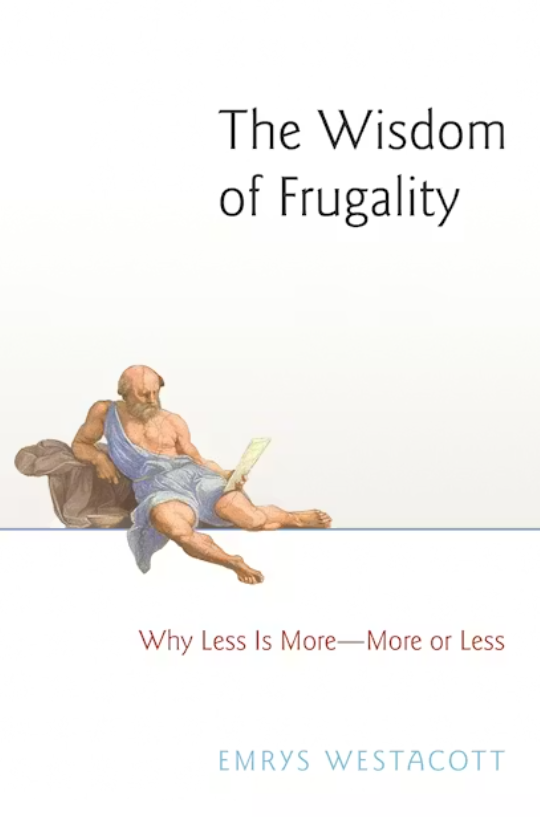
For me, this weakens what could otherwise have been a more compelling case. Insight is offered, but it is not often interrogated. This is quite the contrast to the approach in The Wisdom of Frugality that I discussed recently.
Individual blame versus structural forces
The book gives surprisingly little attention to the historical roots of modern Western individualism. Competitive self-focus is treated as a cultural drift rather than the outcome of centuries of economic development, labour relations, and political design.
This creates a tone that can feel faintly haughty. Responsibility is moralised downward, placed on individuals, rather than traced upward to systems that reward the very behaviours Mackay condemns.
In this respect, The Good Life shares something with Civilised to Death by Christopher Ryan. Ryan’s book, however, is clearer and more persuasive in identifying structural and evolutionary roots of our malaise, rather than framing it primarily as a failure of character.
The Golden Rule at the centre
At its core, The Good Life is an extended meditation on the Golden Rule. To live well is to treat others as you would wish to be treated.
Mackay adds some useful nuance. He adapts the rule to context, including situations involving wrongdoing. The question becomes not whether you would wish to be punished, but how you would wish punishment to be carried out. This reframing grounds morality in empathy rather than purity and gives the rule a bit more practical bite.
Stories and moral persuasion
The book relies heavily on stories, some we assured are real, others fictional, neither declared explicitly so. These are used to illustrate the importance of service, responsibility, and compassion in everyday life.
As narrative devices, they mostly work. They humanise the argument and make it accessible. The difficulty lies not in the stories themselves, but in what Mackay demands of them.
The problem of pure altruism
Mackay spends much effort insisting that actions are only truly good if they are free of self-interest. This is arguably the weakest element of the book.
Taken seriously, it places the Good Life almost entirely out of reach. Human motivation is rarely, if ever pure. Most people act from mixed motives, and this does not automatically corrupt the moral value of their actions.
Mackay undermines his own position with his stories clearly demonstrating how much better life feels for people who consistently serve others. If service reliably improves wellbeing, then self-interest is inevitably involved. The contradiction is never resolved or even acknowledged, and perhaps for the better.
A more credible approach would accept aligned interests rather than deny their existence. Something that Effective Altruism researchers understand well and make the most of. I previously wrote about the instinctive nature of altruism for those wanting to explore this notion further.
Gender, roles, and dated assumptions
There is an uncomfortable moment involving traditional gender roles. A fictional woman’s dissatisfaction in life is attributed to her failure to clean up after her husband and children. She would be living the Good Life, Mackay reasons, if she stopped feeling downtrodden and got back in the kitchen.
The moral lesson feels oddly misjudged. Responsibility is framed narrowly and uncritically, drawing on assumptions that many readers will find dated. Given Mackay’s emphasis on compassion and empathy, this litte “example” left me in some doubt as the credibility of anything else in the book.
Traditional roles may have been more rewarding in some regards, with greater interdependence and clear expectations. But what of the husband’s opportunity to serve his wife, by cleaning up instead? Looking nostalgically to an oppressive past for solutions feels more like a lack of imagination than a serious consideration.
A narrow circle of concern
The greatest limitation of The Good Life, and a contrast with the aims of Living More with Less, is the proximity of its moral horizon. Mackay focuses heavily on family, neighbours, and local community.
There is only one short section devoted to serving larger causes outside of religion, and no consideration of people living in extreme deprivation. The global poor do not appear. Sure, take your elderly neighbour’s bin in for them, but what of the starving teenage mother in a refugee camp and the thousands of children dying daily of preventable diseases?
If we are to assume best intentions than this is less a deliberate choice and more like an omission. It carries an uncomfortable echo of colonial elitism, where concern defaults to those within the author’s familiar social world. A common weakness of most English language productions is the assumption that everyone is WEIRD (Western, educated, industrialised, rich and democratic). This is in spite of this only applying to 20% of the global population, while 66% of the population is English speaking.
Comparison with Peter Singer
Peter Singer’s The Most Good You Can Do addresses many of the same questions about meaning, responsibility, and moral action, but from a very different angle.
Singer foregrounds global need and insists on evidence, scale, and effectiveness. Where Mackay offers moral intuition, Singer offers moral accounting. Where Mackay looks inward, although chastising the reader for making that a motive, Singer looks outward, ambivalent to the motive.
For readers seeking a life of meaning that seriously engages with the distribution of suffering in the world, Singer’s approach is broader, more demanding, and ultimately more transformative. I would put it far higher in any such reading list.
Overall assessment
The Good Life is thoughtful, humane, and often perceptive. It is also padded, narrow, and occasionally blind to its own assumptions.
Its moral instincts are sound, but its scope is limited and its evidentiary base is thin. It provides a few prompts for reflection, but would be far from my first choice as a guide to ethical living.
If living a good life means treating others as we would wish to be treated, the most difficult test is whether we are willing to extend that concern beyond the boundaries of our own comfort and familiarity. I acknowledge that is not always easy to do, but easy and right are not always bedfellows.
Rather than committing hours to this rather empty book, I recommend instead this beautifully written and thoroughly grounded short explanation of how degrowth could lead us to the good life, in every sense of the phrase.